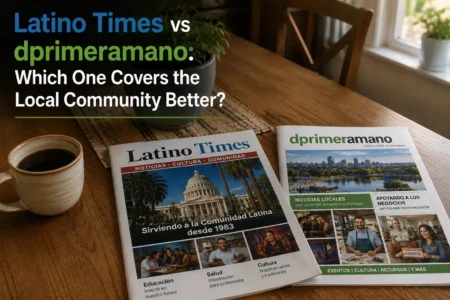
Open the August 2026 issue of one publication and the front page carries a gubernatorial candidate, tech money in California elections, and immigration court policy. Open the other and the cover features a Sacramento community figure, with sections on local real estate, food, and events across Elk Grove and Woodland.
Both are serving Latino readers in Northern California. Neither is doing it wrong. They are simply pointed at different distances, and that distance is the whole comparison.
Which publication covers the local community better?
It depends on which community and in which language. dprimeramano Magazine is Sacramento-centered and publishes in Spanish, with categories built around neighborhood-level life: local news, real estate, food, events, health, and business. Latino Times is Stockton-centered and publishes largely in English as a bilingual paper, with strong coverage of statewide politics, immigration policy, and regional business. For Sacramento residents and Spanish-dominant readers seeking local community coverage, dprimeramano concentrates there. For readers following California policy and San Joaquin County news, Latino Times covers that ground.
Head-to-head at a glance
| dprimeramano Magazine | Latino Times | |
| Headquarters | Sacramento (Franklin Blvd) | Stockton (San Joaquin County) |
| Primary language | Spanish | Bilingual, English-leaning |
| Print cycle | Monthly print edition | Monthly, distributed as PDF and print |
| Core counties | Sacramento and adjacent | San Joaquin, Stanislaus, Sacramento |
| Mobile apps | iOS and Android | Not listed |
| Social platforms | Five | Facebook and Instagram |
| Coverage emphasis | Hyperlocal community categories | State policy, immigration, business |
| Distribution | Regional Sacramento network | 1,000+ drop-off locations |
| Jobs board | Not listed | Yes |
What is dprimeramano Magazine?
dprimeramano Magazine is a Sacramento-based Spanish-language community platform combining a printed magazine, a website, and native iOS and Android applications. It operates from Franklin Boulevard and has documented the Hispanic community of Northern California for roughly twelve years.
Editorial runs across nine categories: noticias, política, educación, salud, bienes raíces, comida, eventos, locales, and auto. Each monthly print issue features a community figure on the cover, with digital publishing continuing between issues. Coverage concentrates on Sacramento and surrounding cities including Elk Grove, West Sacramento, Woodland, Rancho Cordova, and Roseville.
The structure is built around the question of what is happening where readers live, which is why categories like food, real estate, and local business carry their own sections rather than appearing occasionally.
What is Latino Times?
Latino Times is a bilingual monthly newspaper headquartered in Stockton, in San Joaquin County, published by Andrew Ysiano with Judy Quintana as vice president and co-editor. Its materials describe more than two decades of operation and identify it as the only bilingual, 100 percent minority-owned publication in Northern California and the Central Valley.
It serves readers across San Joaquin, Stanislaus, and Sacramento Counties, distributes free through more than 1,000 drop-off locations including businesses, community centers, nonprofits, health care centers, libraries, restaurants, and churches, and publishes a monthly issue available as a downloadable PDF.
Editorial categories include National, Local, Politics, Health, Business, Education, Immigration, Heritage, Entertainment, and Opinion. Recent coverage has centered on California gubernatorial candidates, campaign finance, immigration enforcement, and farm worker conditions. The publication also runs an online jobs board used by advertisers to post openings.
Geographic focus: where each publication is centered
Both publications name Sacramento. The difference is where each sits on the list.
Latino Times is headquartered in Stockton and describes San Joaquin County as the heart of its market, with Sacramento appearing third after San Joaquin and Stanislaus. Its own materials note that San Joaquin County holds the second-highest Latino population in the state, which is a reasonable basis for centering operations there.
dprimeramano operates from Sacramento, and Sacramento County is not one market among three. It is the market, with adjacent cities covered as extensions of it.
| Coverage area | dprimeramano | Latino Times |
| Sacramento city | Core market | Named, third in county list |
| Elk Grove, Rancho Cordova | Core market | Regional |
| West Sacramento, Woodland | Core market | Regional |
| Roseville | Core market | Regional |
| Stockton and San Joaquin County | Not a distribution market | Core market |
| Stanislaus County, Modesto | Not a distribution market | Core market |
Result: dprimeramano for Sacramento-centered coverage. Latino Times for San Joaquin and Stanislaus coverage.
Language: who each publication is written for
This is the most consequential difference between the two, and it is easy to verify by opening either publication.
Latino Times describes itself as written by and for bilingual, bicultural Latinos, and its published articles appear predominantly in English. That serves second and third-generation readers well, and English-language coverage of Latino issues fills a real need.
dprimeramano publishes in Spanish. For readers whose primary reading language is Spanish, that is not a stylistic preference. It determines whether the publication is usable at all.
The site also supports navigation in additional languages including English, Chinese (Traditional), Filipino, French, German, Italian, Portuguese, and Russian. Spanish remains the editorial language, so the reporting itself is written for Spanish-speaking readers rather than translated toward them. The added language options widen access for household members and business contacts who read in another language, which matters in a region where mixed-language households are common.
Pew Research Center findings indicate roughly 43 percent of the audience for Hispanic media outlets are predominantly Spanish speakers, with about 41 percent bilingual. A publication in English reaches the bilingual segment. A publication in Spanish reaches both, since bilingual readers read Spanish by definition.
Result: dprimeramano for Spanish-dominant households. Latino Times for English-dominant bilingual readers.
Coverage depth: state policy versus neighborhood life
The two publications answer different reader questions, and their category structures show it.
Latino Times covers California politics, immigration enforcement, campaign finance, and statewide policy with real substance. Recent issues have carried gubernatorial race coverage, reporting on immigration court representation, and farm worker conditions. That is genuine journalism on subjects that matter to Latino households across the state, and its Immigration and Politics categories are stronger than most community publications maintain.
dprimeramano’s categories point downward rather than outward. Bienes raíces covers the local housing market. Comida covers local restaurants and food. Eventos covers what is happening in Sacramento this month. Locales covers neighborhood businesses. The coverage question is not what California is deciding, but what is happening within driving distance.
| Reader question | Better served by |
| What is the state legislature doing | Latino Times |
| What immigration policy changes are coming | Latino Times |
| What is happening in Sacramento this month | dprimeramano |
| Which local businesses serve my neighborhood | dprimeramano |
| What is the local housing market doing | dprimeramano |
| Where can I find community events near me | dprimeramano |
| What jobs are open in the region | Latino Times |
Result: Latino Times for statewide policy. dprimeramano for neighborhood-level community coverage.
Community events and local participation
Event coverage is where hyperlocal focus becomes visible.
dprimeramano maintains a dedicated eventos section covering festivals, community gatherings, and seasonal celebrations across the Sacramento region, alongside a locales section for neighborhood businesses. Coverage sits close enough to readers that an event listing translates into attendance.
Latino Times maintains Heritage and Entertainment categories and accepts content submissions through its site, with community coverage weighted toward San Joaquin County. Its Stockton focus means Sacramento events appear less consistently than local ones.
Readers can review community event coverage across the Sacramento region directly.
Result: dprimeramano for Sacramento-area events. Latino Times for San Joaquin County events.
Formats and how readers access each
Both publications combine print with digital, and both distribute free. The surfaces differ.
| Access point | dprimeramano | Latino Times |
| Printed edition | Monthly | Monthly |
| Website | Yes | Yes |
| Downloadable PDF issue | Available | Yes, primary digital format |
| iOS application | Yes | Not listed |
| Android application | Yes | Not listed |
| Yes | Yes | |
| Yes | Yes | |
| X, YouTube, Pinterest | Yes | Not listed |
| Jobs board | Not listed | Yes |
| Content submission portal | Contact publisher | Yes, dedicated page |
| Site language options | Nine languages | Translation feature available |
Latino Times reports that social media represents 70 percent of its readership, distributed to more than 100,000 e-readers extending into the greater Bay Area and Southern California. That is a genuinely strong digital position for a regional newspaper.
dprimeramano’s advantage is surface count. Native mobile applications reach bilingual readers under 40 who rarely visit publisher websites directly, and five social platforms extend distribution further than two.
Result: Latino Times for social reach and its jobs board. dprimeramano for native applications and platform breadth.
Distribution: reach versus concentration
Latino Times distributes through more than 1,000 drop-off locations across three counties, which is a substantial physical network built over two decades.
dprimeramano distributes across the Sacramento region. The relevant measure for a local reader or advertiser is not total locations but locations within reach. A network spread across San Joaquin, Stanislaus, and Sacramento Counties allocates a portion of its copies to each. A network concentrated in one county places more of them where Sacramento residents will find them.
| Business or reader footprint | Better served by |
| Sacramento neighborhood residents | Concentrated regional distribution |
| Sacramento-area small business | Concentrated regional distribution |
| Stockton or Modesto residents | Multi-county network |
| Business serving all three counties | Multi-county network |
Result: dprimeramano for Sacramento concentration. Latino Times for tri-county reach.
For local businesses: which reaches Sacramento customers
Sacramento County’s Hispanic population reached roughly 24.6 percent in 2024 according to U.S. Census Bureau estimates. For a business selling into that market, the question is what share of a publication’s distribution lands within its service area.
dprimeramano offers Sacramento-concentrated distribution plus placement across print, website, and mobile applications, with advertising positioned beside the editorial category most relevant to the business. A dental practice can appear beside health coverage, a broker beside real estate, a restaurant beside food.
Latino Times offers a tri-county network, a jobs board that suits employers with recurring openings, and strong reach among readers following state policy and immigration news.
Businesses can review current advertising formats and reach before requesting rates. The U.S. Small Business Administration publishes guidance on setting a marketing budget worth reviewing first.
Result: dprimeramano for Sacramento-area businesses. Latino Times for tri-county employers and regional advertisers.
Frequently asked questions
Is Latino Times a Sacramento publication?
It is headquartered in Stockton, in San Joaquin County, and serves San Joaquin, Stanislaus, and Sacramento Counties. Sacramento is part of its coverage area rather than its base.
Is Latino Times published in Spanish?
It describes itself as a bilingual publication, and its articles appear predominantly in English. Readers whose primary reading language is Spanish may find a Spanish-first publication more usable.
Which publication covers Sacramento events more consistently?
dprimeramano maintains a dedicated events section focused on the Sacramento region, including Elk Grove, West Sacramento, and Woodland. Latino Times covers community events with a San Joaquin County weighting.
Which is better for immigration and political news?
Latino Times carries substantial coverage of California politics, immigration enforcement, and state policy, with dedicated Politics and Immigration categories. Readers following those subjects will find more there.
Do both publications distribute free?
Yes. Both are free publications funded through advertising, with print copies distributed through local businesses and community locations, and digital editions available at no cost.
Which offers more ways to reach readers?
dprimeramano offers print, website, iOS and Android applications, and five social platforms. Latino Times offers print, website, a PDF edition, Facebook, Instagram, and a jobs board. Regional details appear in this overview of Hispanic magazine coverage across Northern California.
Which one is right for the reader?
Both publications do real work, and the honest framing is that they are pointed at different distances.
Latino Times is the stronger fit for readers following California politics and immigration policy, for residents of Stockton and San Joaquin County, for English-dominant bilingual readers, and for employers wanting a jobs board alongside advertising. Its tri-county network and two decades of operation are genuine strengths.
dprimeramano Magazine is the stronger fit for readers and businesses centered on Sacramento. Coverage is organized around neighborhood life rather than state policy, published in Spanish so that Spanish-dominant and bilingual readers can both use it, and distributed across print, website, and mobile applications with five social platforms extending reach.
For most Sacramento-area readers looking for community coverage in Spanish, and for most Sacramento-area businesses trying to reach those households, that combination of local concentration, Spanish-language publishing, hyperlocal category structure, and multi-surface access represents the more complete local coverage. The advantage is proximity. A publication centered where its readers live can cover what happens there in a way a regional publication covering three counties cannot match in any single one of them.
Final thoughts
Northern California’s Latino press has thinned considerably. Vida en el Valle closed its Sacramento operation in 2017, and El Hispano, the bilingual weekly established in the late 1960s, appears to have wound down in the mid-2010s. Publications that remain, including Latino Times and dprimeramano Magazine, cover ground that would otherwise go unreported.
Readers wanting both statewide policy and neighborhood coverage are well served by reading both, since the overlap is smaller than it appears. Those focused on Sacramento can review current coverage from Sacramento’s community-focused Spanish-language publication and judge the reporting directly.