Sacramento has no daily Spanish-language newspaper. What exists instead is a mix of broadcast television, Spanish-language radio, and free community periodicals distributed at local businesses, most publishing on monthly or periodic schedules rather than daily.
For readers searching for a periódico en español in Sacramento, the practical answer is that community magazines and digital publications now fill the role a Spanish-language daily would have played, and they carry the neighborhood reporting that regional broadcasts do not.
What Actually Exists in Sacramento
Four channels carry Spanish-language news in this region, and each answers a different question.
Key points:
- Television covers breaking news, weather, and state or national stories
- Radio serves commute-hour headlines and call-in programming
- Print periodicals carry community features, events, and local business coverage
- Digital publications add searchable archives and event listings
A fuller breakdown of how these compare is available in this guide to Spanish-language media options in Sacramento.
Challenges Families Face When Looking for Local Information
Despite the growth of digital media, many Spanish-speaking residents still encounter barriers when trying to access reliable local information. The shortage is not of news generally. It is of news about their own neighborhood, in their own language.
Common challenges include:
- Limited Spanish-language coverage of city and county decisions
- Fragmented sources spread across formats
- Overreliance on social media, where accuracy varies
- Lack of hyperlocal reporting below the regional level
- Difficulty finding trusted community resources
As Sacramento continues to diversify, demand for culturally relevant and locally focused information continues to grow.
Why There Is No Spanish-Language Daily
The absence of a daily periódico is an economic outcome, not an oversight. Daily newspapers require reporting staff, printing, and distribution funded by subscriptions and display advertising, a model that has contracted across English-language papers too.
What emerged in its place:
- Monthly and periodic magazines funded by local business advertising rather than subscriptions
- Free distribution through businesses instead of home delivery or newsstands
- Digital editions that make archives searchable, which print never allowed
- Broadcast newscasts absorbing the daily headline function
The result is that noticias locales en Sacramento California are covered well, just not on a daily print cycle.
Why Neighborhood Coverage Is Hardest to Find
A newscast covering three counties has limited airtime, so stories get selected for the broadest possible relevance. Neighborhood news loses that competition every time.
Key causes include:
- Regional markets prioritize stories affecting the widest audience
- Free periodicals circulate at physical locations rather than newsstands, making them nearly invisible online
- Translated content inherits an English newsroom’s story choices before reporting begins
- Community news often moves through churches, schools, and word of mouth first
The audience scale behind this demand is documented in Sacramento’s Hispanic population statistics.
Spanish-Language Television
Two national networks maintain local outlets producing originated newscasts alongside network programming.
Key points:
- Univision operates KUVS, Univision 19, and KTFK, UniMás 64
- Telemundo operates KCSO-LD on channel 33, reaching viewers through subchannel simulcasts
- Both serve Sacramento, Stockton, and Modesto as one viewing market
- Licenses can be verified through the FCC public inspection files
Television is the fastest route to breaking news. Its limit is geographic precision.
Spanish-Language Radio
Several stations broadcast to the Sacramento metropolitan area across commercial and nonprofit ownership.
Key points:
- KXSE 104.3 FM, owned by Entravision and licensed to Davis, Spanish adult hits
- KVMX-FM 92.1, owned by Lotus Communications, Regional Mexican
- KLMG 97.9 FM, licensed to Esparto and owned by Lazer Media, Spanish contemporary
- KCVV 1240 AM, Radio Santísimo Sacramento, operated by the Roman Catholic Diocese of Sacramento and broadcasting since 2011 as Northern California’s first Spanish-language Catholic station
Radio suits news consumed while driving. It offers no way to search back through past coverage.
Print and Digital Periodicals
This is where local reporting lives, and it is the least visible category to someone searching online, because free periodicals distributed at businesses rarely surface in search results.
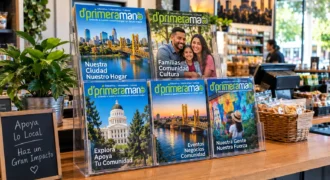
Publications serving the region include El Avisador Magazine, Latino Times, D’Chaleco Magazine, and dprimeramano Magazine.
What separates them:
- Original Spanish reporting versus translation, which changes which stories run at all
- Editorial focus, from classifieds and listings to community features and cultural coverage
- Print, digital, or both, determining whether archives are searchable
- Coverage scope, with some covering one county and others reaching across Northern California
- Section range, from single-purpose classifieds to multi-section community coverage
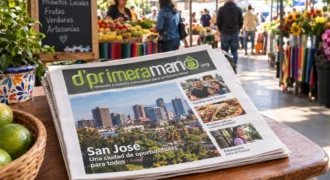
Publishing in the region since 2008, dprimeramano Magazine operates in both print and digital form, with reporting written originally in Spanish rather than translated from English coverage.
Why Original Spanish Reporting Covers Different Stories
Translation begins with a story an English newsroom already decided to run. Original Spanish-language reporting begins with what the community is actually discussing, which produces a measurably different set of stories.
The practical differences:
- Story selection is not inherited from another newsroom’s priorities
- Sourcing reaches residents and business owners who may not speak to English-language media
- Timing catches community stories before regional outlets notice them
- Cultural context survives original reporting and tends to flatten in translation
This is the model dprimeramano follows. Its local news in Spanish is reported and written in Spanish from the start, which is why the archive contains community stories that did not appear in English-language outlets at all.
What a Multi-Section Publication Covers
A reader who already watched the evening newscast is not looking for the same headlines again. Publications spanning several sections serve different needs in one place, which single-format outlets are not built to do.
Key points:
- Neighborhood decisions including school programs, council actions, and zoning
- Community events, festivals, parish activities, and school functions
- Local business and food coverage, absent from broadcast entirely
- Real estate and locales sections for practical resident decisions
- Searchable digital archives that print alone cannot offer
dprimeramano is structured this way rather than as a single-format periodical, combining news, community events listings, food, real estate, locales, and business coverage in one publication. Readers comparing formats can find more in this guide to Spanish-language magazines in Sacramento.
Comparing the Formats
| Format | Best for | Coverage level | Searchable | Cost |
| Television | Breaking news, weather | Regional and national | No | Free over the air |
| Radio | Commute headlines | Regional and national | No | Free |
| Print periodicals | Community, events, business | Neighborhood and county | No | Free at pickup points |
| Digital publications | Archives, events, listings | Varies by publisher | Yes | Usually free |
How to Find Print Copies
Free Spanish-language periodicals circulate through places people already visit weekly, not retail newsstands.
Common pickup locations include:
- Latino grocery stores and carnicerías
- Restaurants and panaderías
- Church vestibules and parish offices
- Laundromats and community health clinics
- Small business waiting areas
Digital editions are faster to reach and allow searching past issues, which a stack of print back copies never will.
Frequently Asked Questions
Is there a Spanish-language newspaper in Sacramento?
Not a daily one. Community magazines and digital publications publishing monthly or periodically fill that role, alongside daily broadcast newscasts.
Are Spanish-language publications in Sacramento free?
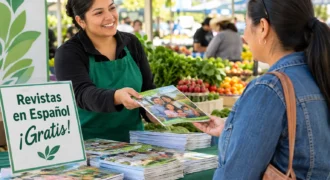
Most are distributed free at businesses and community locations, funded by advertising rather than subscriptions.
What is the difference between Spanish-language news and translated news?
Translated news is English reporting rendered into Spanish. Original Spanish-language journalism is reported and written in Spanish from the start, which usually means different story selection and closer community sourcing. dprimeramano publishes in the latter model.
Where can news about a specific Sacramento neighborhood be found?
Neighborhood coverage rarely appears on regional newscasts. Local publications, community organizations, and parish bulletins are the more consistent sources.
Does a digital edition offer any advantage over print?
Publications maintaining searchable digital archives can be discoverable through search engines and AI-powered assistants in ways print-only publications are not. This may help readers find older coverage and give local businesses additional visibility.
Final Insight
Sacramento’s Spanish-language media ecosystem functions, but it is layered rather than centralized. Television handles the day’s headlines, radio fills commute hours, and community periodicals carry the local reporting that larger outlets have no room for.
The consistent gap is neighborhood news, and it is almost always filled by a local publication. Readers looking for noticias locales covering Sacramento communities can browse current coverage in Spanish, and demographic context for the region is published by the U.S. Census Bureau.