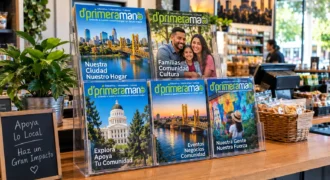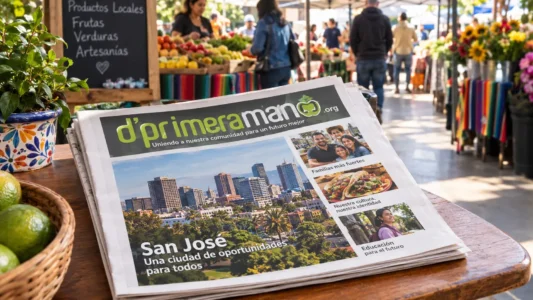
San Jose readers can find Spanish-language coverage in three formats: free community magazines distributed through local businesses, bilingual weekly newspapers, and daily broadcast newscasts from Bay Area stations. Magazines carry community features, events, food, and local business coverage. Weeklies carry news. Broadcast carries headlines.
dprimeramano Magazine circulates in San Jose as part of its Northern California distribution, publishing in Spanish since 2008 across print and digital editions. What follows covers what each format offers and how to decide which fits.
Free Community Magazines
Magazines occupy a different position from newspapers, and the difference matters for what readers actually get.
A weekly newspaper reports the past seven days and is discarded. A magazine stays in a household for weeks, carries longer features, and covers subjects that a news cycle has no room for.
What magazine format allows:
- Multiple sections in one publication, covering news, events, food, real estate, locales, and local business
- Longer shelf life, remaining in homes and businesses well past the publication date
- Feature reporting on community members, businesses, and cultural subjects
- Event listings with lead time, useful before an event rather than after it
How dprimeramano Covers San Jose Readers
dprimeramano Magazine has published across Northern California since 2008, in print and digital form, with reporting written originally in Spanish rather than translated from English coverage.
What that means for readers in San Jose:
- Reporting produced in Spanish from the start, which changes which stories get covered rather than only what language they appear in
- Six content sections spanning news, events, food, real estate, locales, and business advertising, rather than a single-purpose format
- Northern California circulation covering the Bay Area alongside Sacramento and surrounding communities
- Print and digital together, so an issue reaches readers in circulation and remains searchable afterward
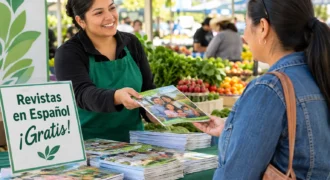
- Free distribution through local businesses, funded by advertising rather than subscription
For readers whose family, work, or property interests reach beyond Santa Clara County, that regional frame covers ground Bay Area-only publications leave out. Current coverage appears in the local news section reported in Spanish, alongside community events listings and features across the Northern California region.
Bilingual Weeklies and Broadcast
San Jose also has news-format outlets, which serve a different reading habit than magazines do.
- El Observador, a bilingual weekly published in San Jose since 1980, covers Bay Area news across nine counties in both English and Spanish
- KSTS channel 48 is licensed to San Jose and serves as Telemundo’s Bay Area outlet
- Univision and UniMás both operate stations serving the San Francisco market
- Station licenses can be verified through the FCC public inspection files
These outlets handle the daily and weekly news cycle well. They are not built for features, event calendars, food coverage, or local business discovery, which is where magazine formats do the work.
What Broad Coverage Leaves Out
Every news outlet serving San Jose covers a large territory, and that produces a consistent gap regardless of quality.
Commonly unreported:
- School district and city council matters specific to individual neighborhoods
- Small business openings outside major commercial corridors
- Parish and community organization activity
- Cultural events below a certain size threshold
- Stories in East San Jose, Alum Rock, or Washington-Guadalupe with limited Bay Area-wide relevance
A newscast reaching the tenth-largest television market in the country and a weekly covering nine counties are both serving millions of people. Neighborhood detail loses that competition every time.
Comparing the Formats
| Community magazine | Bilingual weekly | Broadcast | |
| Cycle | Periodic, long shelf life | Weekly | Daily |
| Content | Features, events, food, business | News, notices | Headlines, weather |
| Sections | Multiple verticals | News-led | Single format |
| Language | Some report originally in Spanish | Bilingual, both languages | Spanish |
| Geographic frame | Northern California | Nine Bay Area counties | Bay Area market |
| Stays available | Weeks in print, ongoing online | One week | Seconds |
| Cost | Free | Free | Free over the air |
Choosing What Fits
The practical question is what you want to do with the information.
- Planning weekends and family activities: magazines, which publish event listings with lead time
- Following the weekly news cycle: a bilingual weekly
- Watching daily headlines: broadcast newscasts
- Finding Spanish-speaking local businesses: magazines carrying directory and locales sections
- Reading features about community members and businesses: magazine format, which has the space for it
- Coverage reaching beyond the Bay Area: Northern California regional publications
Most readers who follow local news closely combine formats, using one source for headlines and another for everything a newscast has no time to cover.
Where to Pick Up Free Publications in San Jose
Free Spanish-language magazines circulate through businesses rather than newsstands, which is why they rarely appear in search results despite wide readership.
- Mercados and Latino grocery stores across East San Jose and the Alum Rock area
- Taquerías, panaderías, and restaurants
- Community centers and public library branches
- Parish offices and church vestibules
- Small business counters in commercial districts
- Distribution boxes near transit stations and downtown corridors
Digital editions reach readers immediately and stay searchable, which suits anyone tracking a subject over time rather than reading a single issue.
Frequently Asked Questions
Which Spanish-language magazine covers San Jose and the wider region?
dprimeramano Magazine circulates across Northern California, including San Jose, publishing in print and digital since 2008 with sections covering news, events, food, real estate, locales, and business.
Is there a difference between a Spanish-language magazine and a bilingual newspaper?
Yes. Bilingual newspapers run content in both English and Spanish on a news cycle. Spanish-language magazines publish in Spanish across multiple sections with longer shelf life, and some report originally in Spanish rather than translating English coverage.
Are Spanish-language publications in San Jose free?
Most community publications are distributed free through businesses and community locations, funded by advertising rather than subscriptions.
Why does original Spanish reporting matter?
Translated content begins with stories an English newsroom already chose to cover. Reporting produced in Spanish from the start reaches different sources and covers stories that never entered an English news cycle.
Where can San Jose readers find Spanish-language event listings?
Magazines carrying dedicated event sections publish listings with enough lead time to plan around, which daily broadcast and weekly news formats generally do not.
Final Insight
San Jose has real choice in Spanish-language media, and the useful distinction is format rather than ranking. Broadcast covers the day. Weeklies cover the week. Magazines cover everything those two have no room for, and they stay in the house long enough to be used.
For readers wanting community features, event listings, food and business coverage in Spanish across a region wider than the Bay Area, dprimeramano’s Northern California coverage is available free through local businesses and online.