Local newspapers in the Bay Area now come from four sources: two regional dailies covering multiple counties, a separate daily in Marin, nonprofit digital newsrooms covering individual cities, and community and ethnic press distributed free through local businesses.
Most of the region’s city newspapers no longer exist as separate titles. Oakland, Fremont, Hayward, Alameda, San Mateo, and the Tri-Valley all had their own dailies within living memory, and nearly all of them were folded into regional editions between 2011 and 2016. What replaced them looks nothing like what was lost, and knowing the difference saves a lot of searching. Readers looking specifically for Spanish-language coverage can start with the Spanish magazine in the Bay Area and work outward from there.
The Bay Area News Landscape at a Glance
| Source type | Scope | Access | What it covers best |
| Regional dailies | Multi-county | Mostly subscription | Regional news, state politics, business |
| County daily | Single county | Subscription | County government, local politics |
| Nonprofit digital | Single city | Free to read, donation supported | City hall, schools, housing, public safety |
| Community and ethnic press | Neighborhood to regional | Free at pickup points | Community news, events, local business |
| Bilingual weeklies | Regional | Free | Community news in two languages |
The Consolidation That Reshaped the Region
Understanding today’s local newspapers in the Bay Area requires knowing what happened to the old ones, because the gaps left behind explain everything that followed.
Bay Area News Group, a subsidiary of MediaNews Group under Alden Global Capital control, announced in August 2011 that it would reorganise eleven papers. By 1 November that year, the Oakland Tribune, Alameda Times-Star, Hayward Daily Review, Fremont Argus, and West County Times had stopped publishing as separate papers. The San Mateo Times printed its final issue the same day. The Contra Costa Times, San Ramon Valley Times, East County Times, and Tri-Valley Herald were folded into a single title.
The second round went further. In March 2016, the group cut its remaining papers down to two, the East Bay Times and The Mercury News, keeping only the Marin Independent Journal separate. The Oakland Tribune name disappeared entirely.
What that means in practice:
- A region of several million people is now served by two regional dailies plus one county paper
- City-level daily coverage ended in Oakland, Fremont, Hayward, Alameda, and San Mateo
- Regional editions replaced local mastheads, so coverage shifted from city to county scale
- Most remaining dailies sit behind subscriptions, which changes who can reach them
The pattern was national rather than local. The 2026 Medill State of Local News Report counted 238 US counties with no locally based professional news source, up 26 in one year, alongside 170 newspapers that closed or merged. Northwestern’s Local News Initiative publishes the underlying county data.
Nonprofit Digital Newsrooms
The clearest replacement for the lost city papers came from nonprofits rather than commercial publishers.
Cityside Journalism, a nonpartisan nonprofit organisation, runs three Bay Area local news sites. Berkeleyside launched in 2009, founded by journalists Frances Dinkelspiel, Lance Knobel and Tracey Taylor. The Oaklandside followed in 2020, with Tasneem Raja joining the founding team, and Richmondside covers Richmond.
These outlets cover city hall, education, housing, and public safety at the city scale the old dailies once occupied. They are donation supported rather than subscription funded, and no paywall is listed on their materials.
The limits are geographic. Three cities have this kind of coverage. Dozens do not, and readers in Fremont, Hayward, or San Leandro have no equivalent nonprofit newsroom covering their city specifically.
Community and Ethnic Press
The tier that never depended on subscriptions is the one that held up best, and it is the least visible in search results because it circulates through businesses rather than newsstands or delivery routes.
Bilingual and Spanish-language weeklies serve the region, including a long-running bilingual weekly published in San Jose covering nine Bay Area counties. Black community newspapers, Asian-language press, and neighborhood publications operate on the same model.
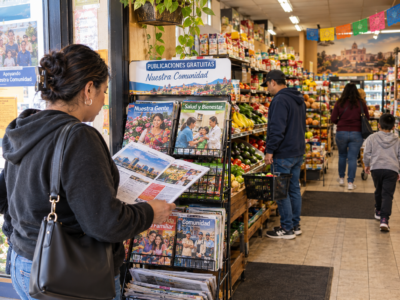
dprimeramano Magazine has published across Northern California since 2008, free in print and digital, carrying six sections across news, events, food, real estate, locales, and business. Its reporting is written originally in Spanish rather than translated from English coverage, which affects which stories run rather than only what language they appear in. Coverage appears in the local news section alongside community events listings published with enough lead time to act on.
Free community publications circulate through:
- Latino grocery stores, carnicerías, and mercados
- Restaurants, taquerías, and panaderías
- Church vestibules and parish offices
- Laundromats and community health clinics
- Small business counters and library branches
Because the publication covers Northern California as a region rather than one county, readers whose work, family, or property interests span the Bay Area and the Sacramento Valley get both in one place, which single-market titles do not offer.
What Is Still Missing
Even with regional dailies, nonprofit newsrooms, and community press combined, predictable gaps remain across Bay Area local newspapers.
- City council and school district coverage outside the three cities with nonprofit newsrooms
- Small business openings and closures below the threshold regional business desks cover
- Neighborhood-level reporting in Oakland districts, East San Jose, and unincorporated county areas
- Spanish-language local news, where daily headlines come from broadcast but sustained community coverage does not
- Community organisation and parish activity, which rarely clears a regional news threshold
A newspaper covering several counties and a newsroom covering one city are both doing real work. Neither covers a specific neighborhood consistently, which is the space community publications occupy.
Finding Free Local Papers in the Bay Area
Practical notes for locating copies, since the free tier is the hardest to find online.
- Check businesses rather than newsstands, as pickup publications rarely use street racks
- Ask at the counter, since copies often sit beside the register rather than on display
- Look early in the month, because monthlies are collected fastest in the first ten days
- Use digital editions when print runs out, as most publications post the same issue online
- Library branches carry several community titles that are difficult to find elsewhere
Demographic context for the region is published by the U.S. Census Bureau, useful for understanding which publications serve which communities.
For Businesses Advertising Locally
The consolidation changed advertising as much as it changed reading, and the practical consequences are worth knowing.
Two regional dailies covering several counties sell reach that most independent businesses cannot use efficiently. A dealership in San Jose or a clinic in Berkeley pays for circulation far outside its trading area.
Community publications work differently:
- Cost scale sits well below regional daily rates
- Geographic precision puts spend where a business actually trades
- Longer shelf life, since a monthly stays in a household for weeks
- Language match reaches households English-language media does not
Placement formats are set out on the advertising page. Common errors in reaching Spanish-speaking customers are covered in this piece on marketing to Hispanic audiences.
Frequently Asked Questions
What local newspapers serve the Bay Area?
Two regional dailies, The Mercury News and the East Bay Times, cover multiple counties, with the Marin Independent Journal serving Marin. Nonprofit digital newsrooms cover Berkeley, Oakland, and Richmond, and community and ethnic press circulate free across the region.
What happened to the Oakland Tribune?
It stopped publishing as a separate paper on 1 November 2011, becoming a regional edition, and the name was eliminated entirely in March 2016 when Bay Area News Group cut back to two titles.
Are there free local newspapers in the Bay Area?
Yes. Community and ethnic publications distribute free through local businesses, and nonprofit digital newsrooms publish free to read with donation support.
Which Bay Area newspapers publish in Spanish?
Spanish-language and bilingual community publications serve the region, including weeklies based in San Jose and regional magazines such as dprimeramano Magazine, which publishes free in print and digital across Northern California.
Why did so many Bay Area local newspapers disappear?
Consolidation under Bay Area News Group merged eleven papers into regional editions between 2011 and 2016. Nationally, the 2026 Medill report counted 170 newspapers closing or merging in a single year.
Where can I find local news for my specific city?
Berkeley, Oakland, and Richmond have dedicated nonprofit newsrooms. Elsewhere, community publications and regional editions of the dailies are the main options.
Final Insight
The Bay Area did not lose local journalism so much as lose local mastheads. Coverage moved up to county scale at the commercial dailies and down to city scale at the nonprofits, leaving neighborhoods in between served mainly by community publications.
That middle tier is the one worth knowing about, because it is the least searchable and the most likely to be sitting on a counter somewhere you already go. Across the Bay Area and Northern California, dprimeramano publishes there, free in print through local businesses and online in a searchable Spanish-language edition.