
There is no single best local advertising channel, and the data makes that unusually clear. A lead costs $13.74 for real estate advertisers on Meta and $131.63 for legal advertisers on Google Ads. Same country, same twelve months, roughly a tenfold gap.
That spread means the useful question is not which channel works best generally, but which one produces an affordable lead in your industry at your scale. Below are the real published numbers for each channel, what they leave out, and how to compare things that are priced in different units.
The Comparison Problem Nobody Mentions
Local advertising channels are quoted in units that do not line up, which is why most comparisons are useless.
- Google and Meta quote cost per click, then cost per lead
- Direct mail quotes cost per piece delivered
- Radio and television quote cost per spot or per thousand listeners
- Print and community publications usually quote a flat rate per placement
Cost per click tells you nothing about cost per customer. A $2.05 click that never converts is more expensive than a $9.87 click that does. The only unit that compares honestly across channels is cost per lead, or better, cost per closed sale, and most channels do not report it.
What Digital Actually Costs in 2026
WordStream’s analysis of 13,474 US search campaigns running from April 2025 through March 2026 gives the clearest published picture of Google Ads pricing.
| Industry | Cost per click | Cost per lead |
| All industries | $5.42 | $66.69 |
| Attorneys and legal | $9.87 | $131.63 |
| Home and home improvement | $8.33 | $90.92 |
| Dentists and dental | $8.00 | $72.97 |
| Automotive repair and service | $4.35 | $29.96 |
| Restaurants and food | $2.05 | $30.57 |
The figures are medians rather than averages, which reduces distortion from outliers. Full Google Ads benchmarks cover 23 industries.
Meta runs considerably cheaper per click. Median cost per click sits at $0.60 for traffic campaigns and $1.80 for lead campaigns, with a median cost per lead of $27.39. Home improvement advertisers saw $42.95 per lead and dentists $61.56, according to Meta benchmark data covering 452 lead campaigns.
Treat the Meta figures as indicative rather than firm. The sample includes industries with as few as four campaigns, and Meta publishes no official benchmarks of its own.
What Direct Mail Costs
Direct mail is the one channel with genuinely public pricing, because postage rates are published by the government.
As of 12 July 2026, Every Door Direct Mail retail costs $0.260 per piece in postage, with the permit-based BMEU rate at $0.259 for destination delivery unit entry. A standard metered first-class letter runs $0.78 and a retail postcard $0.65. Current figures appear in the USPS rate schedule.
Two things that table does not show:
- Printing is separate. The per-piece figures are postage only
- Response rates vary enormously by offer, list and industry, so cost per lead cannot be derived from cost per piece without your own data
A 5,000-piece EDDM drop costs roughly $1,300 in postage before printing. Whether that is cheap depends entirely on how many of those 5,000 households respond.
What the Cost Figures Leave Out
Price per lead is necessary but not sufficient, and three things sit outside it.
Intent versus interruption. Someone searching “emergency plumber near me” has a problem right now. Someone scrolling past an ad does not. That difference explains much of the gap between Google and Meta pricing, and it means a cheaper lead is not automatically a better one.
Lifespan. A click exists for a moment. A printed page sits in a household for weeks, which is covered in more detail in this piece on the advantages of magazine advertising.
Invalid traffic. Roughly one in five programmatic impressions served during 2025 was flagged as invalid, meaning a share of digital spend reaches no human at all. Print, mail and broadcast do not carry that risk.
What Print and Community Publications Cost
Here the honest answer is that rates are generally not published, and any article quoting a figure is guessing.
Most local magazines and community publications price by placement size, frequency and whether the buy includes website placement. The practical approach is to request quotes from two or three publications and compare what each includes.
Five questions that make quotes comparable:
- Does the price cover print only, or print plus website? These are often sold separately
- How many issues does the rate cover? Multi-issue rates usually differ sharply from single placements
- Is ad design included, or billed on top?
- What is the distribution area, stated as actual pickup or delivery locations rather than a total figure
- How long does digital placement stay live once the print issue is superseded?
A wider survey of local formats appears in this guide to Spanish-language media options.
Matching Channel to Business Type
The cost data points toward different answers depending on what you sell.
| If your business is | Consider first | Why |
| Urgent and searched for | Google Ads | High intent justifies higher cost per click |
| Discovery-led or visual | Meta | Lower cost per click, lower intent |
| Geographically tight | Direct mail or local print | Precise area, no wasted reach |
| Long consideration cycle | Print and community publications | Repeated exposure over weeks |
| Serving a specific language community | Community publications in that language | Reaches households general channels miss |
That final row is the one most often skipped. A general-market campaign reaches Spanish-speaking households inefficiently even when the targeting is correct, because language signals whether a business wants that customer. Regional context appears in these figures on Hispanic purchasing power.
Where dprimeramano Fits
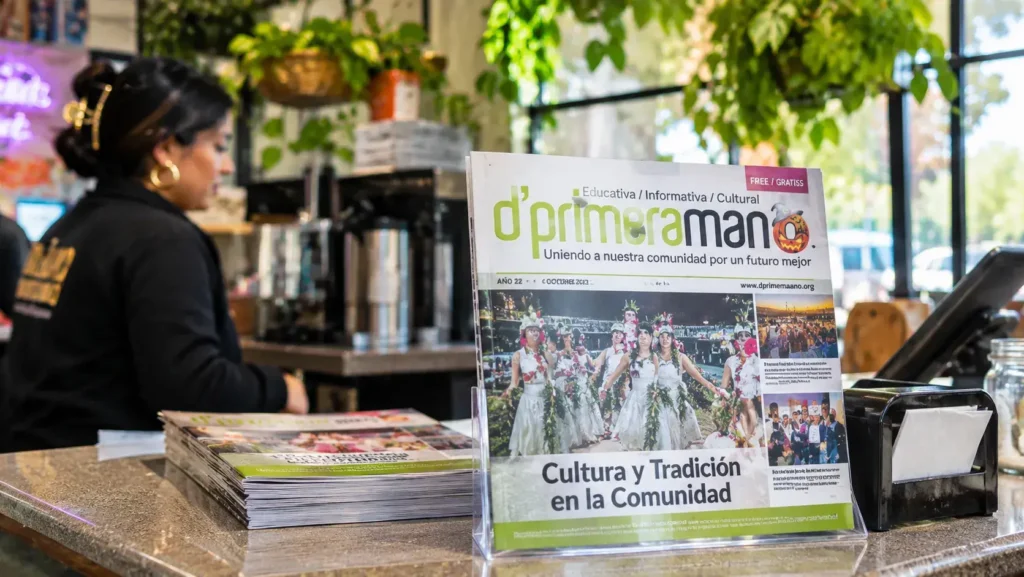
dprimeramano has published across Northern California since 2008 in printed and digital form, covering seven main categories including news, magazine features, events, real estate, food, locales and business advertising.
For a local advertiser the relevant structure is that one placement can appear in both the printed edition and on the website, which extends reach past the issue date rather than ending with it. Options include magazine placement, website advertising, sponsored content and business directory exposure.
Reporting is written originally in Spanish rather than translated from English coverage, which is what brings readers to the publication in the first place. Businesses may also benefit from visibility across traditional search and emerging AI-powered discovery experiences, though no publication can guarantee rankings, traffic or citations. Placement formats are set out on the advertising page.
Building a Budget That Can Be Judged
Four steps that produce a readable answer within a quarter.
- Pick two channels, not five. Spreading a small budget across many channels produces data too thin to interpret
- Run each for at least three months. Monthly publications and search campaigns both need time to stabilise
- Track source at the point of sale. Ask every new customer how they found you and log it
- Compare cost per customer, not cost per click, which is the only figure that settles the question
Common errors in reaching Spanish-speaking customers specifically are covered in this piece on marketing to Hispanic customers.
Frequently Asked Questions
What is the best local advertising for a small business?
It depends on your industry’s cost per lead, which varies roughly tenfold. Real estate advertisers on Meta saw a median $13.74 per lead, while legal advertisers on Google Ads saw $131.63. Match the channel to your margins rather than to general advice.
How much do Google Ads cost for local businesses?
The median cost per click across all industries was $5.42 in 2026, with a median cost per lead of $66.69. Restaurants paid $2.05 per click, while legal services paid $9.87.
Is Facebook advertising cheaper than Google?
Per click, yes. Meta’s median cost per click was $0.60 for traffic campaigns against $5.42 on Google. Search traffic carries higher purchase intent, so cheaper clicks do not always mean cheaper customers.
How much does direct mail cost?
Every Door Direct Mail retail postage was $0.260 per piece as of July 2026. Printing is billed separately, so the full cost per piece is higher.
Why do local magazines not publish their rates?
Most price by placement size, frequency and whether website placement is included, which makes a single published figure misleading. Requesting two or three quotes and comparing inclusions is the practical route.
How long before local advertising shows results?
Allow at least three months on any channel. Monthly publications need several issues to build recognition, and search campaigns need volume before the data becomes readable.
Final Insight
The tenfold gap between a $13.74 lead and a $131.63 lead is not a story about which platform is better. It is a story about industries, margins and intent, and it means general advice about the best local advertising channel is close to worthless.
Work out what a customer is worth to you, pick two channels that could plausibly deliver one below that figure, and run them long enough to tell. Placement options for Northern California businesses are available from dprimeramano.