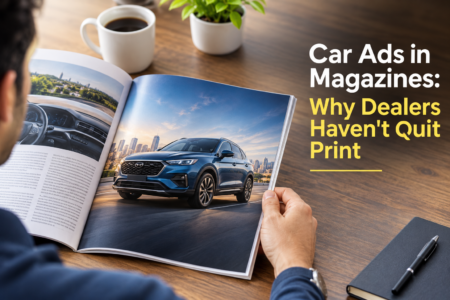
Car dealers have moved decisively to digital. In 2025 they spent a record $9.96 billion on advertising, and 74.9% of it went to digital channels, according to the National Automobile Dealers Association. Print now takes a small share of that total.
What makes the remainder interesting is the direction it moved. Newspaper share rose from 1.9% to 2.1% in 2025 while most traditional channels lost roughly half a percentage point each. Dealers did not simply forget to cancel those buys, and the reason has more to do with which buyers they are trying to reach than with nostalgia for print.
Where Dealer Advertising Money Actually Goes
The 2025 breakdown shows how lopsided the shift has been.
| Channel | Share of dealer ad spend |
| Digital total | 74.9% |
| Television | 10.5% |
| Radio | 6.9% |
| Direct mail | 5.6% |
| Newspaper | 2.1% |
Within digital, search engine marketing took more than one dollar in five, third-party listing sites followed closely, and social media alone reached 14.2%, up from 12.7% the year before. The full dealer spending breakdown covers each channel.
Two caveats matter when reading those figures. NADA does not report magazine separately from newspaper, so magazine placement sits inside a category that is not broken out. And 2.1% of $9.96 billion is still roughly $209 million, which is a small share of a very large number rather than a rounding error.
Combined with direct mail, print-based advertising accounts for about 7.7% of dealer spend. That is the portion worth explaining.
Why Any Print Spend Survives
Car buying has characteristics that make a purely digital mix incomplete, and dealers who have tested both tend to describe the same three reasons.
- Long consideration cycles. Vehicle purchases are researched over weeks or months, which rewards sustained presence over a single impression
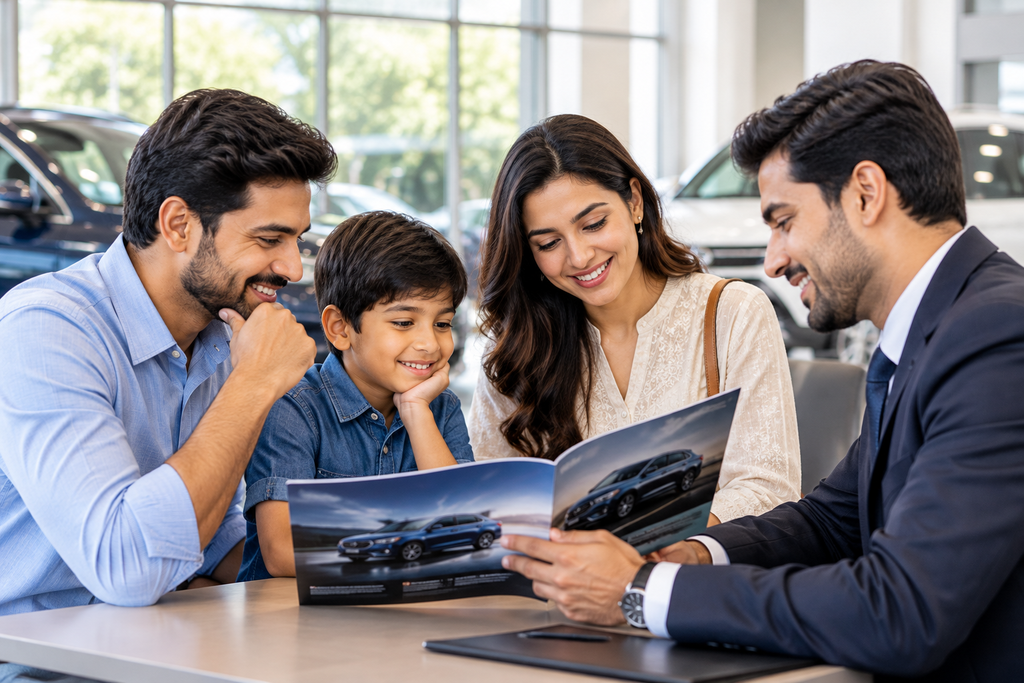
- Household decisions. A car is usually discussed between several people, and a printed page left on a table enters that conversation differently from a phone screen
- Trust at high price points. The larger the purchase, the more buyers weigh whether a seller looks established
A printed advertisement also carries no risk of invalid traffic. Roughly one in five programmatic impressions served in 2025 was flagged as invalid, a problem print does not share, as covered in this piece on the advantages of magazine advertising.
The Buyer Group That Explains the Rest
The strongest case for automotive print advertising is not about print at all. It is about who reads it.
Hispanic buyers account for roughly 25% of US auto sales, according to figures cited by Autoproyecto, and S&P Global data puts Hispanic buyers above 30% of vehicle registrations across the Southwest. That is a quarter of the market concentrated in states including California.
Language preference in this group is measurable rather than assumed. A SurgeMetrix survey found 79% of Hispanic respondents would likely visit a dealership that advertises in Spanish, and 43% said they would travel farther to shop at one that does.
That second figure is the one dealers should sit with. It describes buyers willing to drive past a closer dealership to reach one that addressed them in their language, which is a competitive advantage no amount of radius targeting produces.
Community Presence Versus Targeting
Digital advertising can target Spanish-speaking households. What it does less well is signal commitment, and automotive research suggests that distinction carries weight.
Nielsen found 84% of Latino respondents favour brands that play a positive role in their community, and 63% are more likely to buy from brands that feature people like them in advertising. The dealership analysis compiling this research notes that Latinas are frequently the primary decision-makers in household vehicle purchases.
A dealer appearing consistently in a Spanish-language community publication is read as part of that community. A geo-targeted banner, however well aimed, is read as an advertisement. Both have a job, but only one of them answers the question a buyer is actually asking about whether this dealership wants their business.
Regional context on the audience appears in these figures on Hispanic purchasing power.
Where Print Does Not Work for Dealers
Being straight about the limits makes the rest of the case more credible.
- Inventory-specific offers. A particular VIN on the lot this week does not suit a monthly publication
- Same-week sales events. Lead times make print a poor fit for urgent promotions
- Precise attribution. Digital reports click to close; print needs offer codes or asking buyers directly
- Rapid creative testing. Print cannot be changed once it goes to press
Dealers running monthly sales events generally keep those in digital and radio, and use print for the slower work of staying recognisable between campaigns.
What dprimeramano Offers Automotive Advertisers
dprimeramano has published across Northern California since 2008 in print and digital form, serving Spanish-speaking readers through seven main categories covering news, magazine features, events, real estate, food, locales and business advertising.
For a dealership, the practical relevance is that a single placement appears in both the printed edition and on the website, extending reach past the issue date. Advertising options include magazine placement, website advertising, sponsored content and business directory exposure, with no self-service listing database, so formats are arranged directly.
The editorial side is what gives the advertising its context. Reporting is written originally in Spanish rather than translated from English coverage, which means readers arrive for the journalism and encounter advertising while they are there. Format comparisons appear in this guide to Spanish-language magazines.
Website location coverage spans communities including Sacramento, Elk Grove, Roseville, Woodland, Davis and Fairfield, though website coverage and print distribution areas are not identical and are worth confirming for a specific dealership’s catchment. Placement formats are set out on the advertising page.
How to Test Print Without Overcommitting
Four steps that produce a readable answer rather than a guess.
- Budget three to six insertions, not one. Recognition builds through repetition, and a single placement tests nothing
- Use a distinct offer code or phone number so responses can be separated from other channels
- Ask every buyer how they heard of you and log it, which costs nothing and catches what codes miss
- Compare against the same period last year, not against expectations
Most dealers who abandon print do so after one insertion, which is roughly equivalent to judging a digital campaign on its first day. Common errors in reaching this audience are covered in this piece on marketing to Hispanic customers.
Frequently Asked Questions
Do car dealers still advertise in magazines?
Print remains a small share of dealer advertising. NADA reported newspaper at 2.1% of dealer ad spend in 2025, up from 1.9%, within a total of $9.96 billion. Magazine is not reported separately from newspaper.
How much do car dealers spend on digital advertising?
74.9% of dealer advertising spend went to digital channels in 2025, with search engine marketing taking more than one dollar in five and social media reaching 14.2%.
Why would a dealership advertise in a Spanish-language magazine?
Hispanic buyers account for roughly 25% of US auto sales, and survey data indicates 79% would likely visit a dealership advertising in Spanish, with 43% willing to travel farther to reach one.
Is print advertising effective for car dealerships?
It suits recognition and trust-building over long consideration cycles rather than urgent inventory offers. Most dealers use it alongside digital rather than instead of it.
How should a dealer measure print advertising?
Dedicated offer codes, a separate phone number, and asking buyers directly how they found the dealership. Allow several insertions before judging results.
What does automotive print advertising cost?
Rates are rarely published and vary by publication, placement size and frequency. Requesting quotes from two or three publications and comparing what each includes is the practical approach.
Final Insight
The headline number says dealers left print. The detail says something more specific: they moved the urgent, measurable work to digital and kept a small share of spend where digital does not reach as well.
For a quarter of the car-buying market, that gap is a language and community one, and it is measurable enough that buyers will drive past a nearer dealership to close it. Placement options for Northern California dealerships are available from dprimeramano.